Padel vs Pickleball: Which Sport Is Growing Faster?
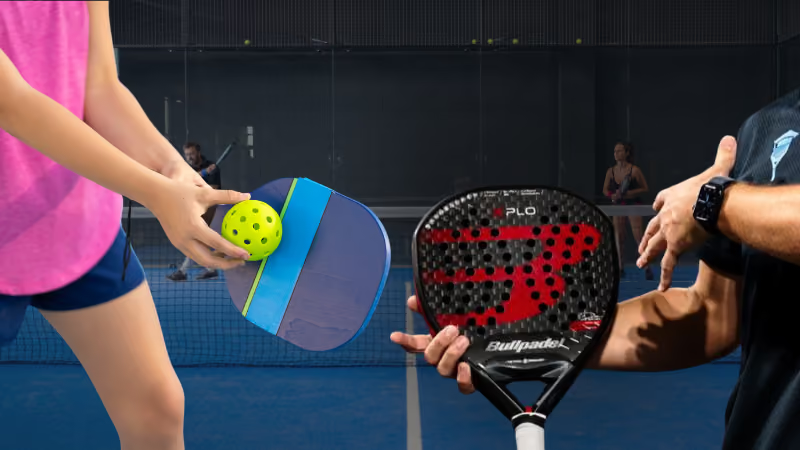
Over the past few years, two racket sports have dominated headlines:
Padel.
Pickleball.
Both are social. Both are accessible. Both are expanding rapidly across new countries. But when it comes to growth, participation, and long-term potential — which sport is actually growing faster?
The answer depends on geography, infrastructure, and how you define “growth.”
Let’s break it down.
The Big Picture: Two Different Growth Stories
Padel and pickleball are both booming — but in very different ways.
- Pickleball has exploded primarily in the United States.
- Padel has expanded globally, especially across Europe, Latin America, and the Middle East.
So when people ask which sport is growing faster, the real question becomes: where?
How Fast Is Padel Growing Worldwide?
Padel has experienced sustained international growth over the last decade.
Originally popular in Spain and Argentina, padel is now expanding across:
- Italy
- Sweden
- France
- The UK
- UAE and Saudi Arabia
- Latin America
- Parts of Asia
The number of courts globally has increased rapidly, especially in countries investing in new club infrastructure. International tournaments and professional tours have further accelerated visibility.
Padel’s growth tends to follow a similar pattern in each new country:
- Early adopters build private clubs.
- Social players drive demand.
- Courts become fully booked.
- National federations and competitive circuits develop.
Its expansion is infrastructure-driven. When courts are built, participation follows.
How Fast Is Pickleball Growing?
Pickleball has seen extraordinary participation growth, particularly in North America.
Its growth has been fueled by:
- Public park installations
- Easy conversion of tennis courts
- Lower infrastructure cost
- Rapid adoption among recreational and older players
Pickleball’s accessibility — especially in the U.S. — has helped it become one of the fastest-growing participation sports in recent years.
Unlike padel, which requires enclosed glass courts, pickleball courts are simpler and cheaper to build. That makes expansion faster in regions with existing tennis facilities.
Which Countries Are Leading in Padel and Pickleball?
Padel Leaders
- Spain remains the strongest padel nation by participation and court numbers.
- Argentina has deep cultural roots in the sport.
- Italy and Sweden have seen massive expansion in recent years.
- The Middle East has invested heavily in premium facilities.
Pickleball Leaders
- The United States dominates globally in both participation and court numbers.
- Canada has seen steady growth.
- Expansion into Asia and Europe is ongoing but less widespread compared to padel’s international footprint.
In short:
- Pickleball is strongest in one major market.
- Padel has broader international spread.
What’s Driving Growth in Each Sport?
Padel Growth Drivers
- Strong club culture and social appeal
- Professional tours and media exposure
- Premium indoor facilities
- Doubles format encouraging teamwork
- Appeal to former tennis and squash players
Padel thrives in urban environments where premium sports facilities are viable.
Pickleball Growth Drivers
- Lower barrier to entry
- Easier court conversion
- Shorter learning curve
- Strong community-based play
- Appeal to a wide age range
Pickleball spreads quickly because it fits easily into existing infrastructure.
Is Padel More Popular Than Pickleball?
Globally, padel may have broader international presence.
In the United States, pickleball is currently far more popular.
Popularity depends heavily on location. In Spain, padel dominates recreational racket sports. In the U.S., pickleball has become a mainstream movement.
Neither sport has fully penetrated every global market yet — which makes both interesting from a long-term growth perspective.
Infrastructure: The Key Difference
One of the biggest differences between padel vs pickleball growth is infrastructure cost.
Padel courts require:
- Glass walls
- Steel structure
- Artificial turf
- Specialized installation
Pickleball courts require:
- Flat surface
- Net
- Painted lines
Because pickleball courts are cheaper to build, they can spread faster in public spaces.
Padel, however, often generates higher revenue per court because of its club-based booking model. This makes it attractive to private investors despite higher upfront costs.
Participation vs Commercial Growth
There’s also a difference between participation growth and commercial growth.
Pickleball has exploded in participation numbers — especially recreational players.
Padel has seen strong commercial investment, professional tours, and premium club development in multiple countries.
Both growth models are strong — but they represent different ecosystems.
What Does the Future Hold for Padel and Pickleball?
Several factors will shape the future of both sports:
- Urban space availability
- Youth development programs
- Media coverage and broadcasting
- Olympic inclusion potential
- Corporate and private investment
Padel continues expanding into new territories with high-end facilities and international events.
Pickleball continues deepening its presence in North America while gradually expanding overseas.
It’s entirely possible that both sports grow simultaneously without directly limiting each other — especially since their strongest markets currently differ.
So… Which Sport Is Growing Faster?
If you measure participation growth in the U.S., pickleball likely leads.
If you measure global court expansion and international spread, padel shows stronger worldwide diversification.
The real takeaway?
Both sports are experiencing significant growth — just in different regions and through different models.
Final Thoughts
Padel vs pickleball isn’t necessarily a competition — it’s a comparison of two sports expanding in different ways.
Pickleball’s strength lies in accessibility and rapid grassroots adoption.
Padel’s strength lies in its social club model, international appeal, and structured professional ecosystem.
The more interesting question may not be which is growing faster — but how each sport continues evolving in its strongest markets.
One thing is clear: racket sports are experiencing a global resurgence. And both padel and pickleball are leading that movement.
Related Posts
Discover more insights, tips, and articles you might find useful